Caro leader,
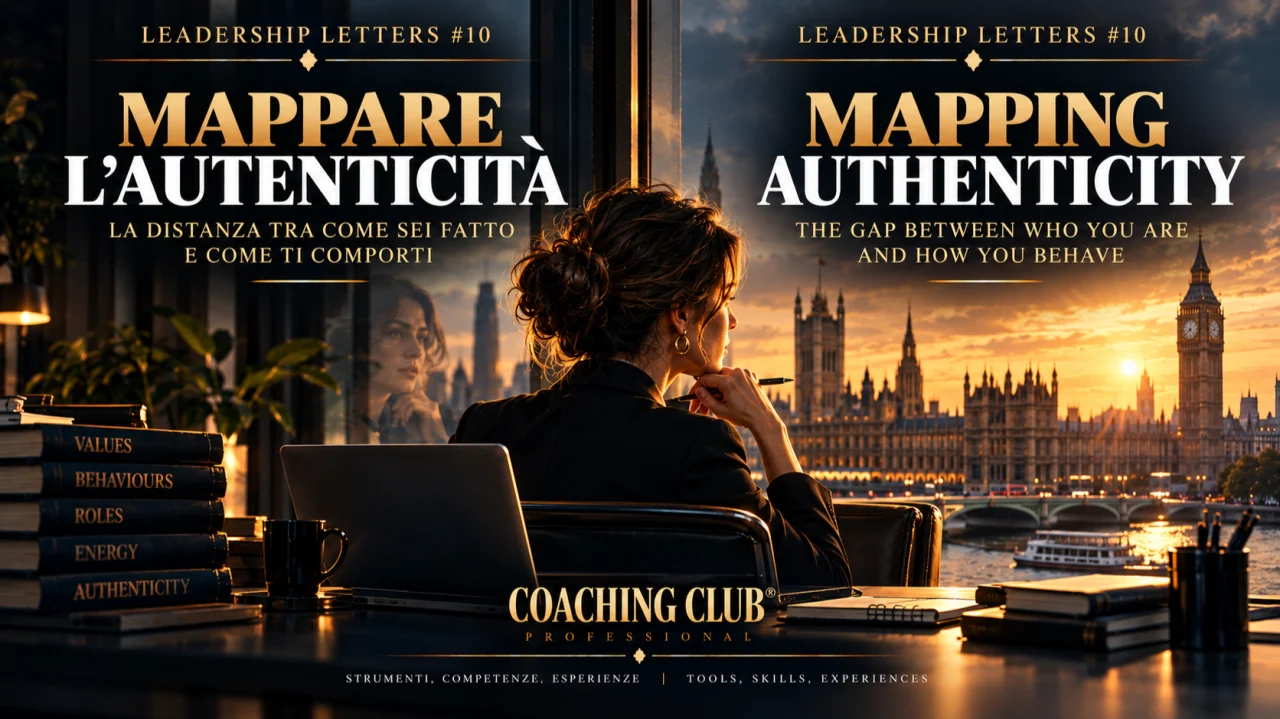
ti hanno detto mille volte di essere autentico. Nessuno ti ha detto come accorgerti di quando non lo sei. Questa lettera prova a dartene un modo: guardare la distanza tra come sei fatto e come ti comporti ogni giorno. Più quella distanza è grande, costante e nascosta, più l'autenticità si consuma.
Il problema
"Sii te stesso" è il consiglio più ripetuto della letteratura sulla leadership. È anche il più inutile, se non sai che cosa sia il tuo "te stesso" e quanto te ne allontani. Molti leader scoprono di essersi allontanati solo quando arriva la stanchezza: la sensazione di recitare una parte, la sera, in macchina, tornando a casa.
Bill George, in True North, chiama autenticità la coerenza tra i propri valori e la propria condotta. Herminia Ibarra, nel suo articolo The Authenticity Paradox, mette in guardia dall'errore opposto: chi si aggrappa a un'idea rigida di sé smette di crescere. Tutti e due hanno ragione. Il punto è avere un dato, e non un'impressione, su dove ti trovi tra questi due rischi.
Un esempio
Prendiamo un caso composito, costruito su situazioni che incontro spesso in coaching. Chiara è direttrice commerciale. Il suo Trait-Map® mostra una Cooperazione alta e un'Assertività bassa: per natura cerca l'accordo e lascia volentieri la scena agli altri.
Il suo ruolo le chiede l'opposto. Negoziazioni dure, riunioni in cui deve imporre una direzione, feedback scomodi al team. Chiara lo fa, e lo fa bene: i colleghi la descrivono come decisa. Ma lei, dopo ogni trattativa, si sente svuotata, e da qualche mese dice di "non riconoscersi più".
Chiara non sta mentendo a nessuno. Sta pagando, ogni giorno, il prezzo di una distanza ampia tra la sua base e il suo comportamento. E nessuno, nemmeno lei, l'aveva mai misurata.
Che cosa dice la ricerca
La psicologia della personalità distingue due livelli. Le tendenze di base sono le disposizioni stabili che un inventario come Trait-Map® misura. Gli adattamenti caratteristici sono i comportamenti che costruiamo per rispondere ai ruoli e alle situazioni (McCrae e Costa, 1996). I due livelli possono divergere, e la ricerca dice che questa divergenza ha conseguenze precise.
La distanza abbassa il senso di autenticità. Sheldon e colleghi (1997) hanno misurato quanto i tratti Big Five delle stesse persone cambiassero da un ruolo all'altro della loro vita. Più la personalità variava tra i ruoli, più le persone si sentivano inautentiche e meno stavano bene. La distanza costa energia. Brian Little (2008) chiama free traits i comportamenti messi in atto contro la propria disposizione, al servizio di un progetto a cui si tiene. Si possono sostenere a lungo, ma consumano risorse e richiedono nicchie di recupero. Zelenski, Santoro e Whelan (2012) hanno mostrato che gli introversi che agiscono da estroversi provano emozioni positive, ma pagano un costo misurabile nelle funzioni esecutive. Recitare logora. La meta-analisi di Hülsheger e Schewe (2011) sul lavoro emotivo mostra che il surface acting, esibire stati che non si provano, è associato a esaurimento emotivo e a minore soddisfazione. Ma l'autenticità non è distanza zero. Fleeson e Wilt (2010) hanno trovato che le persone si sentono più autentiche quando si comportano in modo più estroverso, cooperativo, coscienzioso, stabile e aperto, qualunque sia il loro tratto di partenza. Un comportamento lontano dalla propria base può essere vissuto come pienamente proprio.
Il modello più usato di leadership autentica, quello di Walumbwa e colleghi (2008), ne indica quattro componenti: consapevolezza di sé, trasparenza nelle relazioni, valutazione equilibrata delle informazioni e prospettiva morale interiorizzata. Va detto onestamente che questo costrutto si sovrappone in buona parte alla leadership trasformazionale (Banks et al., 2016). Ma le due componenti più vicine al nostro tema, la consapevolezza di sé e la trasparenza, sono proprio quelle che la distanza mette alla prova.
Mettendo insieme questi studi, la mia lettura è questa: la distanza tra attitudini e comportamenti non è di per sé inautenticità, ma ne è la condizione di rischio. Diventa inautenticità quando è grande, costante, non scelta, senza recupero e nascosta agli altri.
La soluzione: mappare la distanza
Qui entra in gioco Trait-Map®. Lo strumento misura 25 tratti organizzati nei cinque grandi fattori della personalità, con un formato a scelta forzata che riduce la tendenza a rispondere "come si dovrebbe". Il punteggio non dice che cosa sai fare. Dice dove ti muovi senza sforzo e dove, invece, paghi un prezzo. Nel mio lavoro lo chiamo costo energetico.
Accanto al profilo serve una seconda fonte: che cosa ti chiede il ruolo e come ti vedono gli altri. Un 360°, come LC360°, o un colloquio di restituzione strutturato danno questa seconda immagine. Il confronto fa emergere quattro situazioni:
Tratto basso, comportamento basso. Coerenza: nessun costo. Tratto alto, comportamento alto. Coerenza: il comportamento restituisce energia. Tratto basso, comportamento alto. Competenza costruita contro la disposizione: un costo energetico da gestire. Tratto alto, comportamento basso. Il contesto non attiva il tratto o lo scoraggia: una risorsa inespressa.
Per ogni gap, il lavoro non consiste nel "diventare se stessi" né nel "cambiare carattere". Consiste in quattro scelte.
Sceglierla. Questa distanza serve un progetto in cui credo? Se sì, è un free trait e appartiene a me. Se no, è una maschera. Recuperarla. Dove, nella settimana, torno alla mia base? Chiara si è data un'ora dopo ogni trattativa senza riunioni e ha ripreso a lavorare a quattr'occhi con i clienti storici, dove la sua Cooperazione è una forza. Dichiararla. Dire al team "sono una persona che cerca l'accordo, quindi quando insisto su un punto è perché conta" trasforma la distanza in trasparenza. Ridisegnarla. Alcune distanze si riducono cambiando il ruolo, non la persona: delegare una parte delle negoziazioni a chi ha il profilo adatto, strutturare i feedback difficili in un formato che costi meno.
L'autenticità, in questa prospettiva, non è distanza zero. È una distanza conosciuta, scelta, sostenibile e dichiarata.
L'esercizio della settimana (15 minuti)
Scegli i tre tratti in cui senti più fatica nel tuo ruolo. Se hai un profilo Trait-Map®, parti da quelli in cui il tuo punteggio è più lontano da ciò che il ruolo richiede. Per ciascuno, rispondi alle domande qui sotto, con punteggi da 1 a 10. Guarda la risposta su dove recuperi. Se è vuota, hai trovato la tua priorità per il prossimo mese.
Tratto: ____________
La mia base (1-10): Quanto me lo chiede il ruolo (1-10): Distanza (differenza tra i due): Questa distanza serve un progetto in cui credo? Dove recupero: L'ho detto al team?
Ripeti lo schema per ciascuno dei tre tratti.
Una stima fatta da soli è un buon inizio, ma resta un'impressione. Per trasformarla in un dato, la base va misurata con Trait-Map® e il comportamento confrontato con lo sguardo degli altri.
Con stima,
Massimiliano Poltroni
Se vuoi misurare la tua distanza con Trait-Map® e lavorarci in coaching, scrivimi.
Read in English
Dear leader,
you have been told a thousand times to be authentic. Nobody has told you how to notice when you are not. This letter offers one way: look at the distance between how you are made and how you behave every day. The larger, more constant and more hidden that distance is, the more your authenticity wears thin.
The problem
"Be yourself" is the most repeated advice in the leadership literature. It is also the least useful, if you do not know what your "self" is and how far you move away from it. Many leaders discover they have drifted only when the fatigue arrives: the feeling of playing a part, in the car on the way home.
In True North, Bill George defines authenticity as consistency between your values and your conduct. In The Authenticity Paradox, Herminia Ibarra warns against the opposite mistake: leaders who cling to a rigid idea of themselves stop growing. Both are right. What you need is data, not an impression, on where you stand between these two risks.
An example
Take a composite case, built from situations I often meet in coaching. Chiara is a sales director. Her Trait-Map® profile shows high Cooperation and low Assertiveness: by nature she looks for agreement and is happy to let others take the lead.
Her role asks for the opposite. Tough negotiations, meetings where she must set a direction, uncomfortable feedback to her team. Chiara does it, and does it well: her colleagues describe her as decisive. But after every negotiation she feels drained, and for some months she has been saying she "no longer recognises herself".
Chiara is not lying to anyone. Every day she is paying the price of a wide distance between her base and her behaviour. And nobody, herself included, had ever measured it.
What the research says
Personality psychology distinguishes two levels. Basic tendencies are the stable dispositions that an inventory such as Trait-Map® measures. Characteristic adaptations are the behaviours we build to meet roles and situations (McCrae & Costa, 1996). The two levels can diverge, and research shows that the divergence has specific consequences.
Distance lowers felt authenticity. Sheldon and colleagues (1997) measured how much people's Big Five traits shifted across the roles in their lives. The more personality varied across roles, the less authentic people felt and the lower their well-being. Distance costs energy. Brian Little (2008) calls free traits the behaviours we enact against our disposition in the service of a project we care about. They can be sustained for a long time, but they draw on limited resources and need restorative niches. Zelenski, Santoro and Whelan (2012) showed that introverts acting extraverted feel positive emotions but pay a measurable cost in executive functioning. Acting wears you down. Hülsheger and Schewe's (2011) meta-analysis of emotional labour shows that surface acting, displaying states you do not feel, is associated with emotional exhaustion and lower satisfaction. But authenticity is not zero distance. Fleeson and Wilt (2010) found that people feel more authentic when they act more extraverted, agreeable, conscientious, emotionally stable and open, whatever their starting trait. Behaviour far from your base can be experienced as fully your own.
The most widely used model of authentic leadership, by Walumbwa and colleagues (2008), names four components: self-awareness, relational transparency, balanced processing and an internalised moral perspective. In fairness, this construct overlaps substantially with transformational leadership (Banks et al., 2016). But the two components closest to our topic, self-awareness and transparency, are exactly the ones that distance puts to the test.
Putting these studies together, my reading is this: the distance between dispositions and behaviour is not inauthenticity in itself, but it is its risk condition. It becomes inauthenticity when it is large, constant, unchosen, unrecovered and hidden from others.
The solution: map the distance
This is where Trait-Map® comes in. It measures 25 traits organised under the five major personality factors, in a forced-choice format that reduces the pull to answer "as one should". The score does not tell you what you can do. It tells you where you move effortlessly and where you pay a price. In my work I call this the energetic cost.
Next to the profile you need a second source: what your role asks of you and how others see you. A 360° such as LC360°, or a structured feedback interview, provides that second picture. Comparing the two reveals four situations:
Low trait, low behaviour. Consistency: no cost. High trait, high behaviour. Consistency: the behaviour gives energy back. Low trait, high behaviour. Competence built against disposition: an energetic cost to manage. High trait, low behaviour. The context does not activate the trait, or discourages it: an untapped resource.
For each wide distance, the work is neither "becoming yourself" nor "changing your character". It comes down to four choices.
Choose it. Does this distance serve a project I believe in? If so, it is a free trait and it belongs to me. If not, it is a mask. Recover from it. Where in my week do I return to my base? Chiara gave herself an hour with no meetings after each negotiation, and went back to working one-to-one with long-standing clients, where her Cooperation is a strength. Declare it. Telling the team "I look for agreement, so when I insist on a point it is because it matters" turns distance into transparency. Redesign it. Some distances shrink by changing the role, not the person: delegating part of the negotiations to someone with the right profile, or structuring difficult feedback in a format that costs less.
Authenticity, from this perspective, is not zero distance. It is a distance that is known, chosen, sustainable and declared.
This week's exercise (15 minutes)
Pick the three traits where your role tires you most. If you have a Trait-Map® profile, start with those where your score is furthest from what the role requires. For each, answer the questions below, scoring from 1 to 10. Look at your answer on recovery. If it is empty, you have found your priority for next month.
Trait: ____________
My base (1-10): How much my role asks for it (1-10): Distance (the difference between the two): Does this distance serve a project I believe in? Where I recover: Have I told my team?
Repeat for each of the three traits.
A self-estimate is a good start, but it remains an impression. To turn it into data, your base needs to be measured with Trait-Map® and your behaviour compared with how others see you.
Warm regards,
Massimiliano Poltroni
If you would like to measure your own distance with Trait-Map® and work on it in coaching, write to me.
Bibliografia / References
Books of reference for this issue: Bill George, True North (2007), and Herminia Ibarra, The Authenticity Paradox (2015).
Banks, G. C., McCauley, K. D., Gardner, W. L., & Guler, C. E. (2016). A meta-analytic review of authentic and transformational leadership: A test for redundancy. The Leadership Quarterly, 27(4), 634–652. Fleeson, W., & Wilt, J. (2010). The relevance of Big Five trait content in behavior to subjective authenticity: Do high levels of within-person behavioral variability undermine or enable authenticity achievement? Journal of Personality, 78(4), 1353–1382. George, B., with Sims, P. (2007). True North: Discover your authentic leadership. Jossey-Bass. Hülsheger, U. R., & Schewe, A. F. (2011). On the costs and benefits of emotional labor: A meta-analysis of three decades of research. Journal of Occupational Health Psychology, 16(3), 361–389. Ibarra, H. (2015). The authenticity paradox. Harvard Business Review, 93(1/2), 52–59. Little, B. R. (2008). Personal projects and free traits: Personality and motivation reconsidered. Social and Personality Psychology Compass, 2(3), 1235–1254. McCrae, R. R., & Costa, P. T. (1996). Toward a new generation of personality theories: Theoretical contexts for the five-factor model. In J. S. Wiggins (Ed.), The five-factor model of personality: Theoretical perspectives (pp. 51–87). Guilford Press. Sheldon, K. M., Ryan, R. M., Rawsthorne, L. J., & Ilardi, B. (1997). Trait self and true self: Cross-role variation in the Big-Five personality traits and its relations with psychological authenticity and subjective well-being. Journal of Personality and Social Psychology, 73(6), 1380–1393. Walumbwa, F. O., Avolio, B. J., Gardner, W. L., Wernsing, T. S., & Peterson, S. J. (2008). Authentic leadership: Development and validation of a theory-based measure. Journal of Management, 34(1), 89–126. Zelenski, J. M., Santoro, M. S., & Whelan, D. C. (2012). Would introverts be better off if they acted more like extraverts? Exploring emotional and cognitive consequences of counterdispositional behavior. Emotion, 12(2), 290–303.
Trait-Map® and LC360° are instruments created by Gabor Nagy / OD-Tools.com Ltd.