Caro Leader,
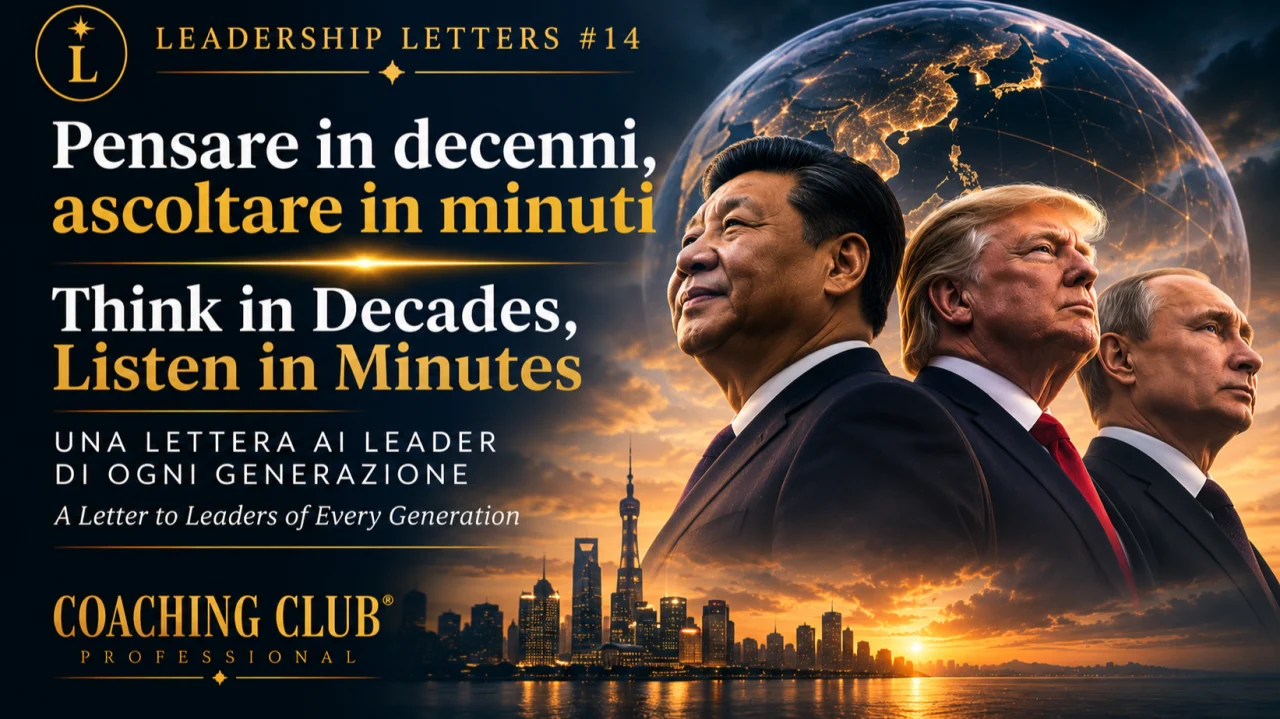
questa settimana, a Shenzhen, Xi Jinping ha ospitato i leader dell’Asia-Pacifico al vertice APEC. Tra loro c’erano Donald Trump e Vladimir Putin. Mentre buona parte del mondo discuteva del prossimo trimestre, lui parlava delle regole del commercio dei prossimi vent’anni.
Non è una lettera di geopolitica, e non prende posizione sul sistema politico cinese. Ti scrivo perché pochi leader oggi mostrano con tanta chiarezza due forze che ogni leader deve governare. La lunghezza dell’orizzonte. E la larghezza del canale da cui ti arriva la verità.
Il problema
La maggior parte delle organizzazioni vive a trimestri. Obiettivi, review, bonus: tutto spinge a vincere i prossimi novanta giorni. Il risultato è una leadership che reagisce bene e costruisce poco.
Chi esce da questa trappola spesso lo fa concentrando le decisioni. Meno voci, esecuzione più rapida, un piano lungo tenuto saldamente da una persona sola. E qui compare un secondo problema: più il potere converge su un leader, meno persone sono disposte a portargli cattive notizie.
L’orizzonte si allunga. Il canale si stringe.
Un esempio — il piano e il silenzio
Partiamo dal caso reale. Xi Jinping ragiona in decenni. Nel 2015 la Cina ha lanciato Made in China 2025, e i suoi obiettivi ufficiali arrivano al 2035 e al 2049, centenario della Repubblica Popolare. Pochi consigli di amministrazione pianificano con questa pazienza.
Nello stesso tempo ha concentrato il potere in una misura che molti analisti non vedevano dai tempi di Mao. Nel 2018 è stato abolito il limite dei due mandati presidenziali, e nel 2022 è iniziato il suo terzo mandato. I sostenitori ci leggono stabilità e continuità. I critici un sistema in cui le informazioni scomode faticano ad arrivare in cima. Entrambe le letture descrivono lo stesso meccanismo, ed è quello che interessa a noi.
Ora una scena più piccola. Pensa ad Andrea (inventato, ma riconoscerai lo schema), fondatore e amministratore delegato di un’azienda di 300 persone. Dieci anni fa ha scommesso su un prodotto in cui nessuno credeva, e aveva ragione. Oggi il suo piano a cinque anni è chiaro, ambizioso, ammirato.
In riunione, però, qualcosa è cambiato. I numeri arrivano già levigati. Il direttore commerciale sapeva da tre mesi che un cliente chiave stava per andarsene, e non ha detto nulla: “Andrea aveva appena presentato il piano al CdA. Non mi sembrava il momento.” Andrea l’ha saputo dal cliente.
Non gli mancava la visione. Gli mancava un canale.
Cosa dice la ricerca
L’orizzonte lungo paga. Il McKinsey Global Institute ha seguito 615 grandi e medie aziende quotate americane dal 2001 al 2014. Quelle guidate con un orientamento di lungo periodo hanno fatto crescere i ricavi di circa il 47% in più delle altre, e con meno oscillazioni lungo la strada.
Poi il costo. Elizabeth Morrison e Frances Milliken hanno descritto quello che chiamano silenzio organizzativo: l’abitudine collettiva di tacere sui problemi. Cresce proprio dove i leader sono lontani, potenti e convinti di sapere già. Le ricerche di Amy Edmondson sulla sicurezza psicologica mostrano l’altro lato. I team parlano degli errori quando credono di non pagarne il prezzo, e quella convinzione dipende soprattutto da come si comporta chi guida.
Kerry Brown, tra i maggiori studiosi occidentali della Cina, ha dato al suo libro su Xi un titolo eloquente: CEO, China. Lo legge come l’amministratore delegato di un’organizzazione gigantesca, più che come un politico tradizionale. È una lente utile anche per noi. Ogni CEO, su scala più piccola, vive lo stesso compromesso tra controllo e informazione.
La soluzione da applicare
Non devi scegliere tra visione e ascolto. Devi costruirli separatamente, perché da soli non crescono insieme.
Per l’orizzonte: scegli una decisione al mese da giudicare su una scala di dieci anni, non sul trimestre. Scrivila con la tua motivazione, così potrai verificarla tra un anno.
Per il canale: rendi economiche le cattive notizie. Ringrazia la prima persona che ti porta un problema, prima ancora di discutere il problema. In ogni colloquio individuale chiedi: “Che cosa dovrei sapere che nessuno mi sta dicendo?” E misuralo, perché chi ti sta intorno raramente ti dirà che ha smesso di dirti le cose.
È qui che LC360°, di cui Coaching Club Professional è distributore ufficiale in Italia, ti aiuta a vederlo con un dato invece che con un’impressione. Mette a confronto come vedi la tua leadership con come la vivono davvero il tuo team, i tuoi pari e i tuoi responsabili. La distanza tra queste due immagini è la larghezza del tuo canale.
Il tuo esercizio
Prenditi dieci minuti, oggi, prima di chiudere questa lettera.
Prima l’orizzonte. Scrivi la decisione più importante che hai sul tavolo questo mese. Poi rispondi a due domande. Cosa deciderei se dovessi risponderne solo per i prossimi novanta giorni? E se dovessi risponderne per i prossimi dieci anni? Se le due risposte coincidono, bene. Se non coincidono, hai trovato il punto in cui il trimestre sta decidendo al posto tuo.
Poi il canale. Scrivi l’ultima cattiva notizia che ti è arrivata da qualcuno del tuo team prima che la scoprissi da solo. Se non ne ricordi nessuna, o risale a più di un mese fa, il tuo canale si sta stringendo. Questa settimana scegli tre persone e fai a ciascuna la stessa domanda: “Qual è una cosa che dovrei sapere e che nessuno mi sta dicendo?” Poi ascolta e basta.
Un piano lungo vale quanto le cattive notizie a cui è permesso di raggiungerlo.
Se conosci un leader con un piano a cinque anni brillante e un team molto silenzioso, inoltragli questa lettera.
Con rispetto, Massimiliano
Dr. Massimiliano Poltroni — Coaching Club Professional
Riferimenti
Brown, K. (2016). CEO, China: The Rise of Xi Jinping. I.B. Tauris.
Edmondson, A. C. (1999). Psychological safety and learning behavior in work teams. Administrative Science Quarterly, 44(2), 350–383.
Edmondson, A. C. (2018). The Fearless Organization. Wiley.
McKinsey Global Institute (2017). Measuring the economic impact of short-termism.
Morrison, E. W., & Milliken, F. J. (2000). Organizational silence: A barrier to change and development in a pluralistic world. Academy of Management Review, 25(4), 706–725.
Read in English
Dear Leader,
this week, in Shenzhen, Xi Jinping hosted the leaders of the Asia-Pacific at the APEC summit. Donald Trump and Vladimir Putin were among them. While much of the world was arguing about the next quarter, he was talking about the trade rules of the next twenty years.
This is not a letter about geopolitics, and it takes no side on China’s political system. I’m writing because few leaders alive today show so clearly two forces that every leader has to manage. The length of the horizon. And the width of the channel through which the truth reaches you.
The problem
Most organisations live by the quarter. Targets, reviews, bonuses: everything pushes us to win the next ninety days. The result is a leadership that reacts well and builds little.
Those who escape that trap often do it by concentrating decisions. Fewer voices, faster execution, a long plan held firmly by one person. And here a second problem appears: the more power converges on a leader, the fewer people are willing to bring them bad news.
The horizon gets longer. The channel gets narrower.
An example — the plan and the silence
Start with the real case. Xi Jinping thinks in decades. In 2015 China launched Made in China 2025, and its official goals stretch to 2035 and to 2049, the centenary of the People’s Republic. Few boards plan with that kind of patience.
At the same time, he has concentrated power to a degree many analysts have not seen since Mao. In 2018 the two-term limit on the presidency was removed, and in 2022 he began a third term. Supporters read this as stability and continuity. Critics read it as a system where contrary information struggles to reach the top. Both readings describe the same mechanism, and that mechanism is the one that concerns us.
Now a smaller scene. Think of Andrea (invented, but you’ll recognise the pattern), founder and CEO of a company of 300 people. Ten years ago he bet on a product nobody believed in, and he was right. Today his five-year plan is clear, ambitious, admired.
In meetings, though, something has changed. The numbers arrive already polished. His sales director knew three months ago that a key client was about to leave, and said nothing: “Andrea had just presented the plan to the board. It didn’t feel like the right moment.” Andrea found out from the client.
He didn’t lack vision. He lacked a channel.
What the research says
The long horizon pays. The McKinsey Global Institute followed 615 large and mid-sized US listed companies from 2001 to 2014. Those run with a long-term orientation grew their revenue about 47% more than the others, with less volatility along the way.
Then the cost. Elizabeth Morrison and Frances Milliken described what they called organisational silence: the shared habit of keeping quiet about problems. It grows precisely where leaders are distant, powerful and convinced they already know. Amy Edmondson’s research on psychological safety shows the other side. Teams speak up about errors when they believe they won’t pay for it, and that belief depends above all on how the person in charge behaves.
Kerry Brown, one of the leading Western scholars of China, gave his book on Xi a telling title: CEO, China. He reads him as the chief executive of a gigantic organisation more than as a traditional politician. It’s a useful lens for us too. Every CEO, on a smaller scale, lives the same trade-off between control and information.
The solution to apply
You don’t have to choose between vision and listening. You have to build them separately, because they don’t grow together on their own.
For the horizon: choose one decision a month that you judge on a ten-year scale, not on the quarter. Write it down with your reason, so you can check it a year from now.
For the channel: make bad news cheap. Thank the first person who brings you a problem, before you discuss the problem. In every one-to-one, ask: “What should I know that nobody is telling me?” And measure it, because the people around you will rarely tell you they’ve stopped telling you things.
This is where LC360°, for which Coaching Club Professional is the official distributor in Italy, helps you see it with data instead of an impression. It compares how you see your own leadership with how your team, your peers and your managers actually experience it. The distance between those two pictures is the width of your channel.
Your exercise
Take ten minutes, today, before you close this letter.
First, the horizon. Write down the most important decision on your desk this month. Then answer two questions. What would I decide if I had to answer only for the next ninety days? And what if I had to answer for the next ten years? If the two answers match, good. If they don’t, you’ve found where the quarter is deciding for you.
Then, the channel. Write down the last piece of bad news you heard from someone in your team before you found it out yourself. If you can’t remember one, or it was more than a month ago, your channel is narrowing. This week, choose three people and ask each of them the same question: “What’s one thing I should know that nobody is telling me?” Then just listen.
A long plan is only as good as the bad news that is allowed to reach it.
If you know a leader with a brilliant five-year plan and a very quiet team, forward them this letter.
With respect, Massimiliano
Dr. Massimiliano Poltroni — Coaching Club Professional